
Section E: GMOs – Boon, Bane, or In Between?
Projected Outcomes
- Students will know the current role transgenic varieties play in the principal field crops of Iowa and Wisconsin.
- Students will become familiar with the major arguments for and against the use of transgenic crop varieties.
- Students will be introduced to some of the politics of science.
Background / Lessons
Introduction
Agriculture began at various places around the world around 10,000 years ago. Throughout the past 10,000 years an important feature of agriculture has been crop selection or breeding. Most of this selection has been in the hands of individual farmers, each of whom had slightly different ideas of what traits he or she wanted, and each of whom was looking to suit the particular needs of his or her farm. Farmers traded some seeds and bought some in times of shortage or to gain new varieties, but most of the time they saved their own from the previous year’s crop. This process resulted in an incredibly wide range of crop varieties in traditional agriculture.
Crop selection and breeding remains an important part of agriculture, but during the last century how it is done has changed markedly. Now it is researchers at universities, special research stations, and for-profit seed production businesses who do the crop selection and breeding that supplies seed for most of the world’s staple crops (for a description of the seed industry in the US see http://www.ers.usda.gov/publications/aib786/). This new system for crop breeding has produced and disseminated some extremely high-yielding crop varieties. It has also taken much seed selection and production out of the control of individual farmers and has vastly reduced the genetic diversity of key crops both in the US and around the world.
Also during the past century new techniques for modifying crops have been developed. The techniques that have attracted the most attention and the most controversy allow technicians to take specific genes from one organism and put them into another organism.
Definitions
Biotechnology refers to “any technique that uses living organisms (or parts of organisms) to make or modify products, to improve plants or animals, or to develop microorganisms for specific uses.” (Definition from the Office of Technology Assessment, as quoted in Jack Kloppenburg. 1988, First the Seed) Strictly speaking, traditional plant breeding and use of naturally-occurring microorganisms for fermentation are forms of biotechnology. However, in common usage the term generally applies to the new technologies of the past few decades, and in particular to the creation of transgenic organisms. These two different usages can create confusion.
Gene transfer or genetic engineering is the process of taking a selected gene from one organism and inserting it into another. Unlike traditional forms of crop breeding, genetic engineering allows the transfer of genes across species and even kingdom boundaries.
Transgenic, genetically engineered, GE, genetically modified organisms, GMOs, and bioengineered are all terms that refer to organisms or crops that have been created by the insertion of a specific gene from another organism through gene transfer.
Current use of GMOs in commercial agriculture
Activity 1. Claims and Counter-claims. Will GMOs Feed the World or Are They Frankenfoods?
Genetically engineered soybeans were first made available to farmers in 1996. As the graph below shows, farmers in the US quickly adopted GE soybeans, corn, and cotton.
The major GE crops currently in use have been modified in two different ways:
Herbicide-tolerant (Ht) crops are engineered so they remain healthy when exposed to a specific herbicide – in most cases glyphosate (Roundup). Roundup-ready soybeans are the main GE crop in Iowa and Wisconsin.
Bt crops are engineered to produce a variety of the bacterium Bt throughout the plant. Bt stands for Bacillus thuringensis. It occurs naturally in the soil and on plants and can produce a protein that is toxic to specific groups of insects. The Bt corn currently in use in Wisconsin and Iowa is toxic to the European Corn Borer, an occasional pest in this region.
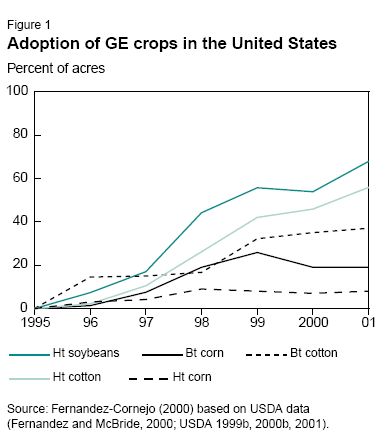
Taken from
Jorge Fernandez-Cornejo and William D. McBride,
May 2002, Adoption of Bioengineered
Crops , ERS Agricultural Economic Report
No. AER810. 67 pp,
http://www.ers.usda.gov/publications/aer810/aer810d.pdf
What benefits do GE crops provide?
Proponents of GE technology have made sweeping claims about the benefits these crops can offer. Let us begin by looking at the crops currently in use in our states: herbicide-tolerant soybeans, Bt corn, and herbicide-tolerant corn.
Benefits to consumers
- These crops do not offer any direct benefits to consumers. Proponents of these crops claim they are substantially equivalent to non-engineered varieties, meaning essentially they are no better and no worse in nutritional quality. Production costs for GE crops are roughly the same as those for conventional crops, and so consumer food prices have not been affected.
Benefits to the environment
- Reduced pesticide use? GE advocates say these crops reduce use of pesticides, while opponents say the claims for pesticide use reduction have been overstated. See section on “What drawbacks are there to GE crops” below and “A Perspective on Actual Versus Potential Environmental Benefits of Agricultural Biotechnology” by Chuck Benbrook at http://www.biotech-info.net/CMB_pew_statement.pdf for a more detailed discussion of the effect of GE crops on pesticide use. Overall, the GE crops used in the Midwest probably have not resulted in lower pesticide use.
Benefits to farmers
- Convenience. Farmers can use one product instead of having to decide among a wide variety of herbicides, each effective on different types of weeds, and with different impacts on the crop. Also, farmers can apply the herbicide at any time without worrying about damage to the growing crop. With Bt crops farmers do not have to monitor pest levels and decide if and when to apply pesticides, and they don’t even have to spray. The pesticide is automatically produced by the plant.
- Effectiveness. Several weeds have begun to develop resistance to the types of herbicides commonly used in soybean production before the introduction of GE varieties. Glyphosate (Roundup) had few resistance problems in the 1990s. However, with the heavy reliance on this product, resistance is starting to emerge.
- Yield increases? (for some crops some of the time). According to USDA data, Bt corn has slightly higher yields than conventional corn varieties on average, while GE soybeans have slightly lower yields than conventional varieties. See study by Michael Duffy, Iowa State University Extension Economist at http://www.leopold.iastate.edu/newsletter/2001-4leoletter/gmo.html.
Benefits to Business
Producers of GE seed expect significant profits from both the seed and from linked herbicide sales. Whether GE ventures will prove profitable in the long term is not yet clear. See http://www.biotech-info.net/monsanto_struggles.html GE crops have also provided a market opportunity for businesses that test for the presence of GE genes in crop samples (e.g., http://www.genetic-id.com/)
What are the costs of GE crops?
Risks for Consumers
Basically, the risks GE corn and soybeans may pose for human health are unknown. Because these crops are deemed to be substantially equivalent to conventional crops, their manufacturers have not had to conduct the types of studies that would be required to approve new pesticides, drugs, or food additives. GE seed producers have voluntarily done some review of their products, but the studies have not been made public in full.
Americans have been consuming GE crops since 1995, and no human health problems have been documented from these products. Why does that experience not prove they are safe?
- Many substances now known to harm human health (e.g. tobacco, pesticides, heavy metals) take years to show ill effects – and don’t harm all people exposed. Because GE foods are not labeled or tracked in the food system, it will be nearly impossible to trace long-term health effects back to them in the way public health researchers have done for tobacco and pesticides.
- GE products are not all the same. Small differences in how they are made may change the risks they pose. For example, in a study by Cornell University, the pollen from some varieties of Bt corn was found to kill Monarch butterflies, while the pollen from other Bt varieties did not appear to harm the butterflies that ate it.
Costs to the environment
As with risks for consumers, there is relatively little concrete information on what the impacts of GE crops are on the environment. The following concerns are based in part on experiences with agricultural pesticides:
- Impacts on non-target organisms. Crops that have built-in pesticides such as Bt may affect organisms other than the pest, including natural predators of the pest species. For example, pollen from some Bt corn varieties is toxic to Monarch butterflies. Follow-up research indicates that in field conditions pollen concentrations on milkweed leaves (the Monarch’s sole food source) are not typically high enough to harm them http://www.ars.usda.gov/is/br/btcorn/index.html. However, possible impacts on a wide range of other organisms have not been studied, though one study raises some concerns http://filebox.vt.edu/cals/cses/chagedor/btnontarget.html. The use of Bt as an insecticide that is sprayed onto plants has been studied. Bt sprays are generally deemed environmentally preferable to standard synthetic pesticides, partially because they have relatively low toxicity for mammals and birds and partially because they break down quickly. However the Bt in GE crops is present in far higher amounts and because it is tied up in plant residue it is much more persistent than sprayed-on Bt.
- Degradation of original crop genotypes. The behavior of GE organisms in the environment over the long term is not yet known. There is some concern that GE traits may be highly competitive with other genotypes, possibly crowding out valuable natural genes. Researchers have found GE genes in corn grown in Oaxaca , Mexico , the center of origin for this crop. Because this region remains the world repository for most of corn’s genetic diversity, production of GE corn was banned in Mexico . There is a lot of controversy about how the GE genes reached Mexico ‘s corn and how much they threaten the genetic pool, but the most likely route seems to be from corn imported from the US , intended for feeding livestock. http://www.gene.ch/genet/2002/Mar/msg00017.html
- Increased pesticide use?
- The numbers of acres treated with herbicides does not change with the adoption of GE crops. What changes is the type of herbicide used. Glyphosate (commercially know as Roundup, the main herbicide used with herbicide-resistant GE crops) is effective at moderate rates, meaning a switch to Glyphosate may result in a decrease or increase in total pounds of active ingredient applied, depending on what product was used before.
- Due to the development of pest resistance, any reductions in pesticide use are likely to be only temporary. A few farmers are already beginning to find some weed resistance to glyphosate, and are mixing it with other pesticides. Some agro-ecologists fear that the long-term result of GE crops may be the loss of glyphosate and Bt as effective, relatively benign pest management tools. GE crop types developed to date fit into the monoculture-pesticides framework rather than the Integrated Pest Management-systems framework.
- Statistics on pesticide use only monitor pesticides applied externally and ignore the pesticides generated by the GE plants themselves.
- Overall, there has probably been no reduction in pesticide use due to the adoption of GE crops in Iowa and Wisconsin. Virtually all corn and soybean acres continue to be treated with herbicides, and corn was rarely treated for European Corn Borer before the introduction of Bt varieties. (Bt varieties have reduced pesticide use on cotton in parts of the US, China, and Africa. Whether these reductions will last is another question.)
Activity 2. Modeling Natural Selection
Costs to farmers
- Loss of international markets. Consumers in the European Union and Japan, two of the major export markets for Midwestern corn and soybeans, do not want GE products. The US is fighting import restrictions on these products through institutions regulating international trade, but their success has been mixed to date. http://www.globalpolicy.org/socecon/trade/gmos/index.htm http://www.ers.usda.gov/publications/wrs984/wrs984e.pdf
- Problems for organic producers. Organic standards prohibit the use of GE products because of the many unknowns about their long-term ecological and health impacts. Unfortunately, since corn (and canola) are wind-pollinated and pollen can travel at least a kilometer under certain conditions, it is very difficult to keep the crop free of GE contamination. Organic farmers can take a variety of steps to reduce the chance of GE contamination of their crop (see http://www.organicconsumers.org/Organic/riddleonge012302.cfm). However, these measures impose extra costs, either directly, or in the form of additional labor or yield losses (e.g., from delayed planting of corn).
- Development of resistance leading to loss of useful pesticides (see above)
- Loss of ability to save seed. Virtually all the corn planted in the US is hybrid. Hybrid corn has high yields, but the seed does not produce the desirable characteristics of the parent plants, so farmers buy new corn seed every year from specialized seed companies, and have done so for decades. However, soybean varieties are not hybrid, so farmers can save part of their crop from one year to use as seed the next. But they are not allowed to do so with GE seed. A number of farmers have had to pay large penalties for deliberately or inadvertently planting saved GE seed. http://www.biotech-info.net/nelsons_frustrations.html, http://deltafarmpress.com/ar/farming_monsanto_dpl_win/
Activity 3: Who Cares About Intellectual Property?
Costs to business
- Organic grain handlers and exporters have incurred additional costs for testing shipments for GMOs. In a few cases entire shipments of organic grains have been rejected due to GE contamination, leading to financial losses for organic farmers and handlers
To sum it all up, the only clear benefit from GE crops in the Midwest to date is the increased convenience of weed management for some farmers using herbicide-tolerant soybeans. The only clear cost to date has been to organic farmers and processors, whose work has become more difficult, expensive, and fraught with an extra layer of uncertainty, and to those farmers who have paid substantial penalties for allegedly planting saved GE seed. The other costs and benefits are uncertain, speculative, or a matter of debate.
What about costs and benefits of GMOs in the future?
Here we enter a realm of even more speculation and uncertainty, and it is difficult, if not impossible, to fairly and accurately sum up the claims on either side. The list below provides a tiny sampling of the range of positions.
Claims and Counterclaims
| CLAIM | DISCUSSION |
| Genetic engineering has the potential to solve world hunger by producing crops that can overcome all environmental challenges and deliver vastly greater nutritional benefits. Only rich and selfish or completely irrational people could possibly oppose these important benefits for humankind. | The world already produces enough food to feed all the world’s people well. The reason there is hunger is because the food is not distributed equally. Genetic engineering will not solve the social causes of hunger and malnutrition. However, GE might conceivably solve some localized shortages or help make some social solutions easier to accomplish. |
| Genetic engineering could result in sterility of key agricultural crops, leading to widespread famine. At a minimum it will put the world’s food supply even more firmly in the hands of a few mega-corporations. Only blind corporate greed or completely irrational people could possibly want to take these risks. | While it is true that one strand of GE research is developing ways to keep crop seeds from growing without a special release product, it seems unlikely that this trait would spread out of control. Also, this is only one of many avenues of GE research, no organization has announced plans to apply this “terminator” technology, and it is probably not in the interest of either corporations or governments to cause famine. |
| GE crops can make currently expensive drugs affordable, curing the sick and enriching farmers at the same time. | The practice of using genetic engineering to get crops to synthesize costly drugs might bring down drug costs, but it also poses very high risks of these drugs getting into the general food supply. Even during extremely restricted preliminary field testing of “pharming” some grain engineered to contain drugs accidentally got mixed in with the regular grain supply at the local coop. Moreover, in most cases what keeps drug costs high is the cost of development and testing and the desire for companies to show a profit, not the actual manufacturing costs. |
| GE crops will increase poverty and hunger by making farmers even more dependent on big business and by favoring rich landowners at the expense of poor subsistence farmers. | Just as the technology of genetic engineering will not solve the social problem of poverty, so it is not the cause of this social problem. However, it is true that in the current economic structure, genetic engineering is closely associated with business systems that have hurt many poor farmers. |
| GE crops will eliminate the need for toxic pesticides. | So far, the only GE crop that has resulted in significant reductions of pesticide use is Bt cotton, and even for Bt cotton, the reductions are uneven and unlikely to last. Integrated pest management (IPM) has more potential to achieve great and lasting reductions in pesticide use, but agri-business has shown little interest in promoting IPM. |
Conclusion
At this point, there is not much evidence to back up either the claims for or against genetic engineering. Given the large amount of uncertainty, the debate comes down to one of philosophical positions.
The position of the proponents of genetic engineering might be summed up as follows: new technologies can make life better, and the progress they bring should not be impeded unless it is proven they cause harm. Or “nothing ventured, nothing gained” and “innocent until proven guilty.”
The position of those concerned about the risks of genetic engineering has been called the precautionary principle. In brief it states that powerful technologies have often been accompanied by unanticipated problems; that the more powerful the technology is, the greater and more insoluble the problems are likely to be, and that therefore it makes sense to require the proponent of a new technology to prove that it will not cause great harm. Or “look before you leap.” http://www.biotech-info.net/rachels_586.html
Most of the negotiation about the role of GMOs is where on the continuum between the two positions government regulation should be.
This discussion only skims the surface of the debate about the use of GE crops. Feelings run high on this topic, and there has been much polarization and name-calling on both sides, some blatant and some disguised. Below are very brief summaries of three areas of controversy.
- The Rhetoric and Politics of Science: Arpad Pusztai and Ignacio H. Chapela (MS Word Document)
- Who owns genes? (MS Word Document)
- Can consumers be trusted with information? (to be developed)
See http://www.biotech-info.net/ for more information
Career Pathway content standards
| Projected Outcome | National Agricultural Education Standards Performance Element or Performance Indicators | Activity Number(s) (in this section) |
|---|---|---|
| 1. List arguments for and against transgenic varieties. | BS.01 Recognize the historical, social, cultural and potential applications for biotechnology. BS.01.03 Analyze the ethical, legal, social and cultural issues relating to biotechnology. BS.03.01 Evaluate the application of genetic engineering to improve products of AFNR systems. CS.02.04 Mental Growth: demonstrate the effective application of reasoning, thinking, and coping skills. CS.03.02 Decision Making – analyze situations and execute an appropriate course of action. CS.10 Technical Skills – envision emerging technology and globalization to project its influence on widespread markets. | E-1 |
| 2. Discuss the affects of politics on science. | BS.01.02 Determine regulatory issues and identify agencies associated with biotechnology. CS.06 Examine the importance of health, safety, and environmental management systems in organizations and their importance to performance and regulatory compliance. | E-2, E-3 |