

Webinar Summary: Dr. Marco Formentini, University of Trento

“Digitalization of Agrifood Supply Chains, and the Impact on Social Sustainability and Fair Value Redistribution”
with Dr. Marco Formentini, University of Trento, Friday February 20, 2026
Dr. Formentini presented his work on how digitalization can transform agri-food supply chains to improve sustainability, reduce food loss and waste, and enable fairer redistribution of value among supply chain actors. More than seventy participants attended the webinar, hosted by CIAS, campus partners, and the National Science Foundation’s AI Institute ICICLE.
He began by situating the work within the broader sustainability agenda articulated in the Sustainable Development Goals and particularly the goal of reducing food loss and waste across the supply chain. Drawing on a systematic literature review, he examined how digital technologies—such as artificial intelligence, big data analytics, blockchain, digital platforms, intelligent packaging, and digital twins—are used to prevent and reduce waste. While the literature shows promise, it remains relatively immature and heavily focused on downstream actors like retailers and consumers. Upstream actors, particularly farmers and processors, are underexamined. Moreover, much of the research is exploratory and lacks strong theoretical grounding, robust measurement of impact, and attention to governance mechanisms. The central insight is that digital tools cannot simply optimize isolated firms; they must be embedded within coordinated supply chain structures to generate meaningful environmental, economic, and social outcomes.
Formentini then discussed a longitudinal case study of the Italian platform Regusto, which assists businesses to redistribute surplus food. Initially operating as a business-to-consumer platform, Regusto later shifted toward a business-to-business and nonprofit model, partnering with companies, municipalities, and charities. A key turning point was the adoption of blockchain technology, which enabled traceability and the measurement of environmental impact. By translating food donations into carbon credits, the platform created a new revenue stream and strengthened its financial sustainability. The case illustrates how digitalization can support sustainable business model innovation—providing transparency, accountability, and measurable impact—while reinforcing collaboration across a network of actors.
Building on this, Formentini challenged traditional supply chain paradigms rooted in lean management and zero-waste efficiency. In agri-food systems, strict efficiency models can conflict with social and environmental objectives. Some degree of surplus, for example, enables redistribution to food-insecure populations. Food waste therefore cannot be treated merely as operational inefficiency; it carries ethical and social dimensions. Formentini calls for a reconceptualization of waste in supply chain research—one that incorporates sustainability trade-offs, social impact, and the realities of agricultural uncertainty.
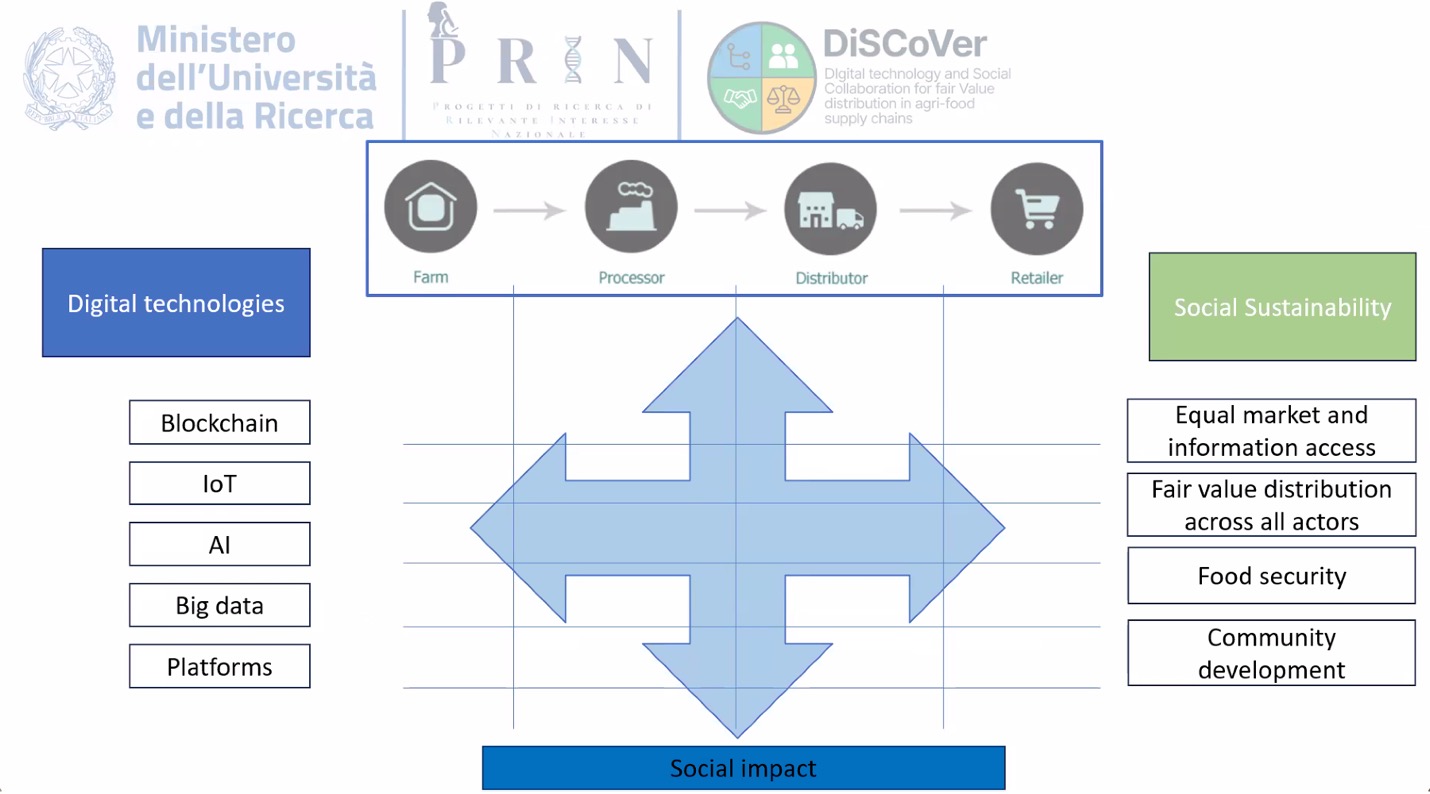
The final portion of the talk introduced a national Italian research project examining how Industry 4.0 technologies can contribute to fair value redistribution in agri-food supply chains. The core question is not only how digital tools improve efficiency, but how they reshape governance mechanisms, negotiation structures, contracts, and business models. In particular, the project explores how digitalization might strengthen the position of actors with lower bargaining power, such as farmers, and foster more equitable outcomes.
This theme is illustrated through the case of Barilla. Facing volatility in durum wheat markets, Barilla developed innovative cultivation contracts with Italian farmers that combined partial price guarantees, quality premiums, and sustainability incentives. Supported by digital decision-support tools, these contracts encouraged environmentally responsible farming while stabilizing farmer income. The result was a model in which both the company and farmers benefited—Barilla reduced procurement risk and environmental impact, while farmers received more predictable returns. The case demonstrates how governance mechanisms, when paired with digital tools, can move supply chain relationships from zero-sum negotiations toward shared value creation.
Overall, the talk argues that digitalization is not inherently transformative. Its impact depends on how it is embedded within governance structures, contracts, and collaborative networks. When aligned with sustainability goals and fair value distribution, digital technologies can support not only operational improvements but also social sustainability and more resilient agri-food systems.
At the end of the talk, the questions from the audience focused on three main themes: measurement and scalability, trade-offs between efficiency and redistribution, and the real-world feasibility of fair value redistribution. Formentini responded by reinforcing the central argument of his presentation: digitalization matters, but governance and institutional design matter more.
Throughout the Q&A, Formentini consistently returned to three themes:
- Digitalization is a tool, not a solution by itself.
- Governance mechanisms—contracts, incentives, transparency—are central.
- Sustainability and fairness must be designed into supply chain relationships.
His answers reinforced the talk’s core thesis: transforming agri-food supply chains requires that we couple technological innovation with institutional and contractual innovation to achieve environmental sustainability, social responsibility, and fairer value distribution.
On Measuring Impact and Scalability: One audience member asked how impact—particularly environmental and social impact—is measured and verified, especially in cases like surplus redistribution and carbon credit generation.
Formentini acknowledged that measurement remains a major challenge. He emphasized that many initiatives are still developing robust metrics and that the academic literature lacks strong quantitative evidence linking digital interventions directly to sustainability outcomes. However, he argued that technologies such as blockchain and digital traceability systems create the infrastructure necessary for credible measurement. In the Regusto example, traceability allowed surplus redistribution to be translated into measurable carbon savings. The key, he stressed, is not the technology alone but the combination of digital tools with transparent governance systems.
On Lean Efficiency vs. Redistribution: Another question challenged his critique of lean and zero-inventory logic: if surplus enables redistribution, does that mean inefficiency is desirable?
Formentini clarified that he was not advocating inefficiency. Rather, he argued that agri-food systems operate under biological uncertainty and social obligations that differ from industrial manufacturing. A purely lean model may minimize inventory but ignore ethical responsibilities and food security considerations. His response reframed the issue as one of system design: supply chains must balance efficiency with resilience and social purpose. Surplus is not inherently good—but recognizing its redistribution potential changes how we conceptualize waste.
On Farmer Bargaining Power and Fair Value Redistribution: A key question concerned whether digitalization truly strengthens farmers’ bargaining power, or whether dominant firms still capture most of the value.
Formentini responded cautiously but optimistically. He acknowledged that power asymmetries persist. Digitalization does not automatically shift power. However, when embedded in structured contracts—like those used by Barilla—it can support more equitable outcomes. In the Barilla case, digital agronomic tools, sustainability metrics, and contract design worked together to provide price stability, quality incentives, and environmental premiums. The innovation, he emphasized, lies in governance mechanisms that align incentives rather than rely solely on market pricing.
He reiterated that moving from “win–lose” to “win–win” outcomes requires deliberate contract design and collaboration—not just technological adoption.
On Generalizability Across Contexts: The concluding question addressed whether these models are transferable beyond Italy.
Formentini noted that institutional contexts differ, especially regarding regulation, market concentration, and agricultural structure. While specific contractual arrangements may not be universally replicable, the underlying principle—integrating digitalization with governance to create shared value—is broadly applicable. What changes is the institutional configuration.
Biography: Prof. Formentini is the deputy director of the Executive MBA in Trento. He holds degrees in Management Engineering (University of Udine, Italy) and a Doctoral Degree (PhD) in Management Engineering (University of Padova, Italy). He has been Associate Professor at Audencia Business School, Nantes (France), Lecturer at the School of Management, University of Bath (UK) and Post-Doc Research Fellow at Cass Business School, City University London (UK) (now Bayes Business School). He is the Principal Investigator for the PRIN Project “Digital technologies and social sustainability: Harnessing digitalization for a fair distribution of value within agri-food supply chains”, Project ID 2022ZPBB9M – CUP E53C24002950006
Credits: This webinar series is made possible by the ICICLE – Intelligent CI with Computational Learning in the Environment – U.S. National Science Foundation AI Center under OAC-2112606 and organized by the University of Wisconsin-College of Agricultural and Life Sciences Center for Integrated Agricultural Systems, with support from several UW partners: the Grainger Center for Supply Chain Management, the Kaufman Lab, Center for Sustainability and the Global Environment (SAGE), Organic Collaborative, Center for Cooperatives, and the Food Studies Network.