
Summer Research Minigrant Program
2025 - Azevedo-Casey, Khomenkov, Mehre, Perry, Schmidt
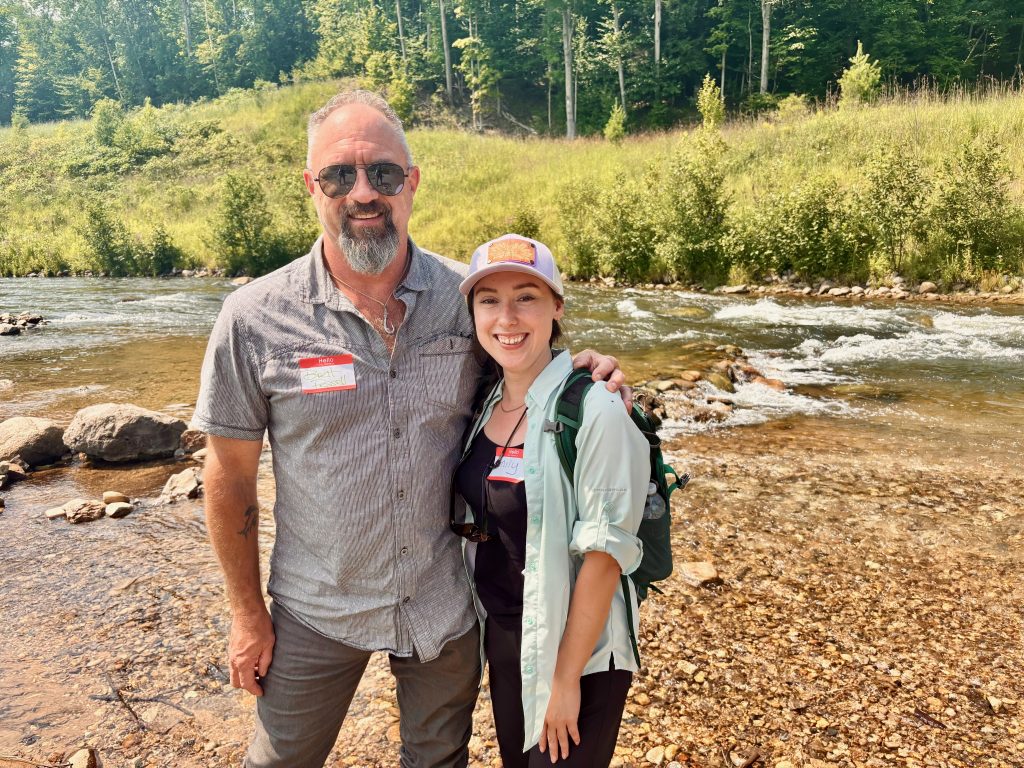
Emily Azevedo-Casey (right) and Brett Fessell (left), River Section Lead for the Grand Traverse Band of Ottawa and Chippewa Indians (GTB), at the former Boardman impoundment site in Grand Traverse County, Michigan. GTB served as the local sponsor and contracting partner for the dam removal, demonstrating Tribal leadership in restoration governance. Emily’s CIAS-supported research examines how such community-led efforts advance social-ecological renewal and food sovereignty.
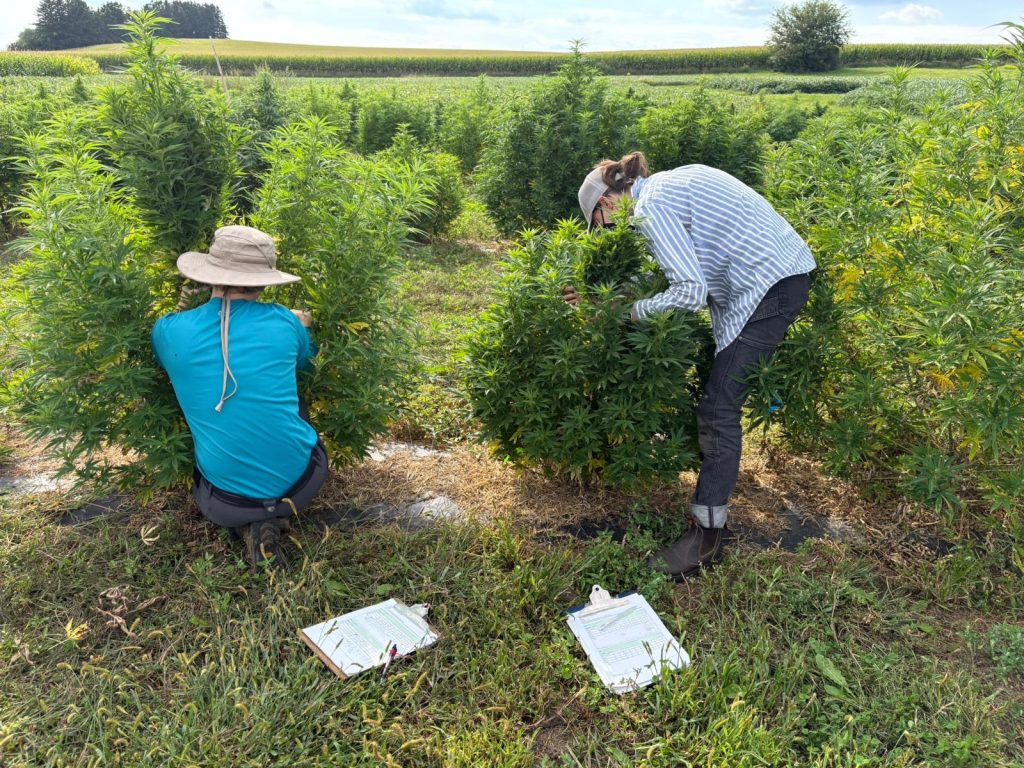
Sophie Perry (Agroecology Masters student, right) and Robin Grygleski (undergrad field technician, left) count larvae borer damage on hemp plants at the Arlington Agricultural Research Station.
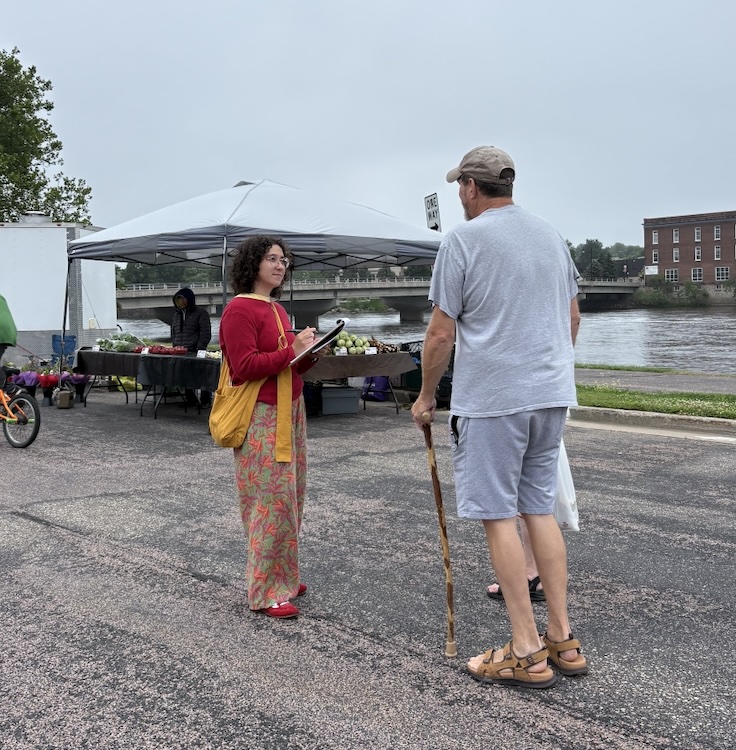
Liz Khomenkov, researcher with the Kaufman Lab for the Study and Design of Food Systems and Marketplaces, interviews Farmer’s Market visitors about their market habits and food access.
Danielle Schmidt interviewed ranchers in northeastern Montana for her study on agricultural land transitioning to conservation reserves.
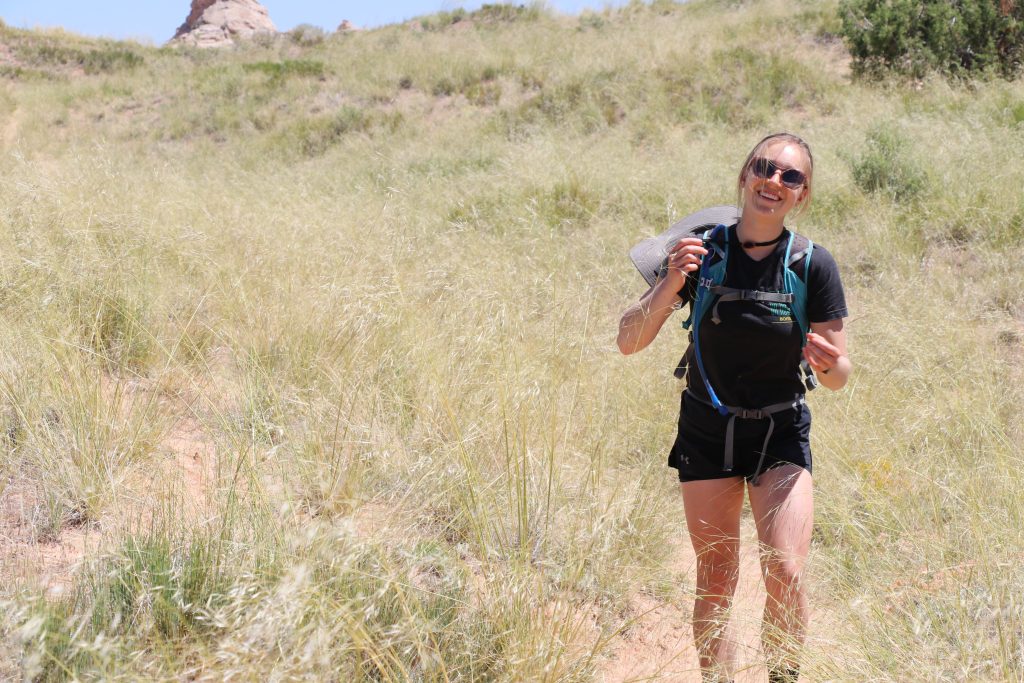
Jessica Mehre, PhD Student in the Nelson Institute for Environmental Studies, pairs soil science and human geography to explore pathways to sustainable agriculture in Wisconsin.
Summary
Community-Based River Restoration and Indigenous Environmental Justice in Water Governance
Student Researcher: Emily Azevedo-Casey, PhD Student, Environment and Resources, Nelson Institute for Environmental Studies
Faculty Advisor: Robert Beattie, Faculty Associate and Co-Director, Community Environmental Scholars Program, Nelson Institute for Environmental Studies
The CIAS Mini-Grant supported a three-week (August 4th to 23rd, 2025) field visit from Madison, WI to Grand Traverse County, MI advancing my community-engaged research with the Grand Traverse Band of Ottawa and Chippewa Indians (GTB). The funding provided critical travel and living support, as well as honorariums that allowed me to appropriately recognize the time, knowledge, and cultural guidance of my collaborators. As a first-generation student, this grant support was transformative by enabling fieldwork that directly advanced CIAS’ goals of equity, participatory action, and food sovereignty research by centering indigenous leadership in watershed governance.
Strengthening the Ecosystem Services Tool (ESS Tool) for Sustainable Decision-Making and Marketing Among Direct-to-Market Farmers in Wisconsin
Student Researcher: Liz Khomenkov, MS Student, Agroecology, Department of Planning and Landscape Architecture
Faculty Advisor: Edna Ely-Ledesma, Associate Professor, Department of Planning and Landscape Architecture
This project, “Strengthening the Ecosystem Services Tool (ESS Tool) for Sustainable Decision-Making and Marketing Among Direct-to-Market Farmers in Wisconsin,” aimed to enhance communication between farmers and consumers by helping producers showcase their ecological practices through market infographics. Working with the Central Wisconsin Farmers Market Collaborative (CWFMC), the team prioritized equity by centering the needs of underserved, direct-to-market farmers and those serving low-income communities. Farmers used the Ecosystem Services (ESS) Tool to create infographics highlighting their sustainable practices, which were displayed at farmers markets, aiming to foster consumer engagement and support climate-smart purchasing. While farmer participants reported that the infographics were easy to display and beneficial for reflecting on their own practices, customer interaction with the graphics was limited. This suggests a need for improved design to better capture farmer’s market visitors’ attention. Nevertheless, the process of completing the ESS Tool encouraged farmers to evaluate and strengthen their regenerative agriculture methods, supporting more informed decision-making and community connections within Wisconsin’s local food systems.
Exploring perennial agriculture in east-central Wisconsin through rootedness in place
Student Researcher: Jessica Mehre, PhD Student, Environment and Resources, Nelson Institute for Environmental Studies
Faculty Advisor: Randall Jackson, Professor, Department of Plant and Agroecosystem Sciences
All farming occurs in a place. The physical structure and function of each place carry different meanings about what is right or wrong, about what is possible, for farmers and the land. In turn, how farmers understand what is right and possible shapes the physical structure and function of agriculture in a region. Research on sustainable agriculture, namely the establishment of perennial grasslands, should explore place-based understandings of farming and agriculture so that clean water, healthy soil, and profitable farms are maintained across the landscape. This summer, Jessica visited dozens of farmers in east-central Wisconsin to learn about how and why they farm and the challenges and opportunities they see for the future of agriculture in east-central Wisconsin. These conversations highlighted place-based understanding of what farming could and should be. The local knowledge and relationships built during these informal farm visits will aid in Jessica’s future dissertation research, with next steps including formal interviews with farmers and community members and facilitated discussion forums to explore outcome-based agricultural goals for the region.
Assessment of damage by main borer pests to the marketability of hemp in the Midwest
Student Researcher: Sophie Perry, MS Student, Agroecology, Department of Entomology
Faculty Advisor: Christelle Guédot, Associate Professor, Department of Entomology
The U.S. hemp (Cannabis sativa L.) industry, once an important crop for fiber production in the U.S. and particularly in the Midwest, has been reemerging in the last decade. In 2023, the hemp industry was valued at $291 million in the U.S. However, with this rapid industry expansion, research has been slow at keeping pace to support farmers. Little information is available on key Midwest hemp pests and cultivars resistant to them. Growers, extension professionals, and researchers in the region have identified three potential main pests in cannabidiol (CBD) hemp: Eurasian hemp borer (EHB), European corn borer (ECB), and corn earworm (CEW). In addition to causing physical damage, insect herbivory can increase the production of the cannabinoid tetrahydrocannabinol (THC), possibly exceeding the legal limit of 0.03%, which would result in the rejection of the crop. Here, we seek to better understand the physical damage potential of these borer pests, as well as their potential to change hemp crop cannabinoid content. We will assess the feeding injury of these borer pests across four CBD hemp cultivars via sampling larvae counts biweekly. We will also assess the impact of EHB feeding on the levels of CBD hemp through lab herbivory assays. We will use a gas chromatograph (GC) coupled to a mass spectrometer (MS) to analyze the THC and CBD content of hemp samples. This research will assist growers in better understanding the damage potential of main borer pests and what cultivars to select to prevent pest infestation.
Reserved: The Transition of US Agricultural Land to Conservation Reserves
Student Researcher: Danielle Schmidt, PhD Student, Sociology, Department of Community and Environmental Sociology
Faculty Advisor: Katherine Curtis, Buttel-Sewell Professor, Department of Community and Environmental Sociology
My mixed-methods dissertation project examines the process and implications of agricultural land transitioning to conservation. I draw on interviews and other field-based data collection techniques to consider how agricultural land transitions change landscapes and the rural communities within them. With financial support from CIAS, this summer I conducted interviews with agricultural producers in four northeastern Montana counties. These interviews encompassed diverse perspectives from producers who lease from or have considered selling to a local conservation organization; young producers who have recently inherited land or who are seeking ways to acquire land of their own; producers part of multi-generational operations; community and industry advocates; and adjacent industry professionals. In my preliminary analysis of these data, I find producers are concerned about land market pressures in ways they haven’t been before. Young producers in particular are motivated by these challenges to adapt their operations for improved economic and environmental sustainability. Further, findings continue to strongly suggest conservation and production are not opposing missions; however, in certain spatial and cultural contexts, stakeholders have a ways to go in developing shared visions of land use and tenure.